Download PDF Refactoring Databases: Evolutionary Database Design (Addison-Wesley Signature Series (Fowler)) By Scott W. Ambler, Pramod J. Sadalage
Reading absolutely this book could develop the specific need as well as severe methods to undertake and also overcome this issue. Book as a home window of the globe could have the specific circumstance of how this publication is presented. Refactoring Databases: Evolutionary Database Design (Addison-Wesley Signature Series (Fowler)) By Scott W. Ambler, Pramod J. Sadalage as we recommend being prospect to check out has some advancements. Besides it is checked out from exact same subject as you need, it has also fascinating title to read. You can additionally see just how the style of the cover is stylised. They are actually well done without frustration.
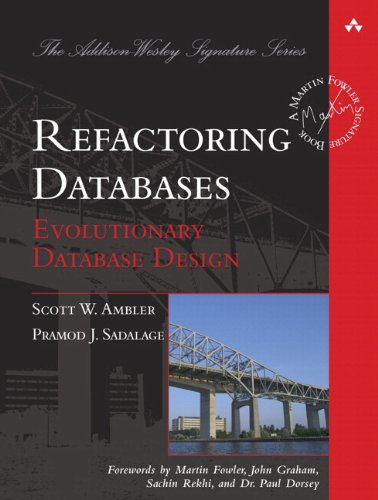
Refactoring Databases: Evolutionary Database Design (Addison-Wesley Signature Series (Fowler)) By Scott W. Ambler, Pramod J. Sadalage

Download PDF Refactoring Databases: Evolutionary Database Design (Addison-Wesley Signature Series (Fowler)) By Scott W. Ambler, Pramod J. Sadalage
In fitting the new upgraded book launched, we pertain to you. We are the internet website that always provides an extremely fantastic method, terrific term, and also terrific checklists of the collections books from several countries. Book as a fashion to spread out the information as well as information regarding the life, social, sciences, religions, several others holds an essential policy. Publication could not as the fashion when they are out of date, they will certainly work as nothing.
Currently, your time is to create the different ambience of your life. You may not really feel that it will certainly be so peaceful to recognize that this book is absolutely yours. As well as how you could await the book to review, you could simply discover the web link that has been given in this site. This site will certainly offer you all soft duplicate fie of the book that can be so easy to discover. Associated with this condition, you can really realize that the book is attached constantly with the life and also future.
This book has to be had by every person that like reading or have reading routine. You can take extra benefits of reviewing Refactoring Databases: Evolutionary Database Design (Addison-Wesley Signature Series (Fowler)) By Scott W. Ambler, Pramod J. Sadalage The lesson of this book is not always the facts. It will certainly be additionally such point that will make you amazed of this publication. You recognize, in undergoing this life, lots of people need to have the experience as well as understanding from many resources. It is to make sure that you can subsequent the method of how some people life.
In addition, when you have the analysis practice, it will certainly lead you to keep and go forward for far better condition. A publication as one of the windows to reach better world can be achieved by positioning the knowledge. Even you have no concepts regarding the book previously, you can recognize increasingly more after beginning with the initial page. So, exactly what do you consider Refactoring Databases: Evolutionary Database Design (Addison-Wesley Signature Series (Fowler)) By Scott W. Ambler, Pramod J. Sadalage that you can take it to read from currently?
- Sales Rank: #310016 in eBooks
- Published on: 2006-03-03
- Released on: 2006-03-03
- Format: Kindle eBook
From the Back Cover
Refactoring has proven its value in a wide range of development projects–helping software professionals improve system designs, maintainability, extensibility, and performance. Now, for the first time, leading agile methodologist Scott Ambler and renowned consultant Pramodkumar Sadalage introduce powerful refactoring techniques specifically designed for database systems.
Ambler and Sadalage demonstrate how small changes to table structures, data, stored procedures, and triggers can significantly enhance virtually any database design–without changing semantics. You’ll learn how to evolve database schemas in step with source code–and become far more effective in projects relying on iterative, agile methodologies.
This comprehensive guide and reference helps you overcome the practical obstacles to refactoring real-world databases by covering every fundamental concept underlying database refactoring. Using start-to-finish examples, the authors walk you through refactoring simple standalone database applications as well as sophisticated multi-application scenarios. You’ll master every task involved in refactoring database schemas, and discover best practices for deploying refactorings in even the most complex production environments.
The second half of this book systematically covers five major categories of database refactorings. You’ll learn how to use refactoring to enhance database structure, data quality, and referential integrity; and how to refactor both architectures and methods. This book provides an extensive set of examples built with Oracle and Java and easily adaptable for other languages, such as C#, C++, or VB.NET, and other databases, such as DB2, SQL Server, MySQL, and Sybase.
Using this book’s techniques and examples, you can reduce waste, rework, risk, and cost–and build database systems capable of evolving smoothly, far into the future.
About the Author
Scott W. Ambler is a software process improvement (SPI) consultant living just north of Toronto. He is founder and practice leader of the Agile Modeling (AM) (www.agilemodeling.com), Agile Data (AD) (www.agiledata.org), Enterprise Unified Process (EUP) (www.enterpriseunifiedprocess.com), and Agile Unified Process (AUP) (www.ambysoft.com/unifiedprocess) methodologies. Scott is the (co-)author of several books, including Agile Modeling (John Wiley & Sons, 2002), Agile Database Techniques (John Wiley & Sons, 2003), The Object Primer, Third Edition (Cambridge University Press, 2004), The Enterprise Unified Process (Prentice Hall, 2005), and The Elements of UML 2.0 Style (Cambridge University Press, 2005). Scott is a contributing editor with Software Development magazine (www.sdmagazine.com) and has spoken and keynoted at a wide variety of international conferences, including Software Development, UML World, Object Expo, Java Expo, and Application Development. Scott graduated from the University of Toronto with a Master of Information Science. In his spare time Scott studies the Goju Ryu and Kobudo styles of karate.
Pramod J. Sadalage is a consultant for ThoughtWorks, an enterprise application development and integration company. He first pioneered the practices and processes of evolutionary database design and database refactoring in 1999 while working on a large J2EE application using the Extreme Programming (XP) methodology. Since then, Pramod has applied the practices and processes to many projects. Pramod writes and speaks about database administration on evolutionary projects, the adoption of evolutionary processes with regard to databases, and evolutionary practices’ impact upon database administration, in order to make it easy for everyone to use evolutionary design in regards to databases. When he is not working, you can find him spending time with his wife and daughter and trying to improve his running.
Excerpt. © Reprinted by permission. All rights reserved.
Refactoring DatabasesRefactoring Databases Evolutionary Database DesignPreface
Evolutionary, and often agile, software development methodologies, such as Extreme Programming (XP), Scrum, the Rational Unified Process (RUP), the Agile Unified Process (AUP), and Feature-Driven Development (FDD), have taken the information technology (IT) industry by storm over the past few years. For the sake of definition, an evolutionary method is one that is both iterative and incremental in nature, and an agile method is evolutionary and highly collaborative in nature. Furthermore, agile techniques such as refactoring, pair programming, Test-Driven Development (TDD), and Agile Model-Driven Development (AMDD) are also making headway into IT organizations. These methods and techniques have been developed and have evolved in a grassroots manner over the years, being honed in the software trenches, as it were, instead of formulated in ivory towers. In short, this evolutionary and agile stuff seems to work incredibly well in practice.
In the seminal book Refactoring, Martin Fowler describes a refactoring as a small change to your source code that improves its design without changing its semantics. In other words, you improve the quality of your work without breaking or adding anything. In the book, Martin discusses the idea that just as it is possible to refactor your application source code, it is also possible to refactor your database schema. However, he states that database refactoring is quite hard because of the significant levels of coupling associated with databases, and therefore he chose to leave it out of his book.
Since 1999 when Refactoring was published, the two of us have found ways to refactor database schemas. Initially, we worked separately, running into each other at conferences such as Software Development (http://www.sdexpo.com) and on mailing lists (http://www.agiledata.org/feedback.html). We discussed ideas, attended each other's conference tutorials and presentations, and quickly discovered that our ideas and techniques overlapped and were highly compatible with one another. So we joined forces to write this book, to share our experiences and techniques at evolving database schemas via refactoring.
The examples throughout the book are written in Java, Hibernate, and Oracle code. Virtually every database refactoring description includes code to modify the database schema itself, and for some of the more interesting refactorings, we show the effects they would have on Java application code. Because all databases are not created alike, we include discussions of alternative implementation strategies when important nuances exist between database products. In some instances we discuss alternative implementations of an aspect of a refactoring using Oracle-specific features such as the SE,T UNUSED or RENAME TO commands, and many of our code examples take advantage of Oracle's COMMENT ON feature. Other database products include other features that make database refactoring easier, and a good DBA will know how to take advantage of these things. Better yet, in the future database refactoring tools will do this for us. Furthermore, we have kept the Java code simple enough so that you should be able to convert it to C#, C++, or even Visual Basic with little problem at all.
Why Evolutionary Database Development?Evolutionary database development is a concept whose time has come. Instead of trying to design your database schema up front early in the project, you instead build it up throughout the life of a project to reflect the changing requirements defined by your stakeholders. Like it or not, requirements change as your project progresses. Traditional approaches have denied this fundamental reality and have tried to "manage change," a euphemism for preventing change, through various means. Practitioners of modern development techniques instead choose to embrace change and follow techniques that enable them to evolve their work in step with evolving requirements. Programmers have adopted techniques such as TDD, refactoring, and AMDD and have built new development tools to make this easy. As we have done this, we have realized that we also need techniques and tools to support evolutionary database development.
Advantages to an evolutionary approach to database development include the following:
You minimize waste. An evolutionary, just-in-time (JIT) approach enables you to avoid the inevitable wastage inherent in serial techniques when requirements change. Any early investment in detailed requirements, architecture, and design artifacts is lost when a requirement is later found to be no longer needed. If you have the skills to do the work up front, clearly you must have the skills to do the same work JIT.
You avoid significant rework. As you will see in Chapter 1, "Evolutionary Database Development," you should still do some initial modeling up front to think major issues through, issues that could potentially lead to significant rework if identified late in the project; you just do not need to investigate the details early.
You always know that your system works. With an evolutionary approach, you regularly produce working software, even if it is just deployed into a demo environment, which works. When you have a new, working version of the system every week or two, you dramatically reduce your project's risk.
You always know that your database design is the highest quality possible. This is exactly what database refactoring is all about: improving your schema design a little bit at a time.
You work in a compatible manner with developers. Developers work in an evolutionary manner, and if data professionals want to be effective members of modern development teams, they also need to choose to work in an evolutionary manner.
You reduce the overall effort. By working in an evolutionary manner, you only do the work that you actually need today and no more.
There are also several disadvantages to evolutionary database development:
Cultural impediments exist. Many data professionals prefer to follow a serial approach to software development, often insisting that some form of detailed logical and physical data models be created and baselined before programming begins. Modern methodologies have abandoned this approach as being too inefficient and risky, thereby leaving many data professionals in the cold. Worse yet, many of the "thought leaders" in the data community are people who cut their teeth in the 1970s and 1980s but who missed the object revolution of the 1990s, and thereby missed gaining experience in evolutionary development. The world changed, but they did not seem to change with it. As you will learn in this book, it is not only possible for data professionals to work in an evolutionary, if not agile, manner, it is in fact a preferable way to work.
Learning curve. It takes time to learn these new techniques, and even longer if you also need to change a serial mindset into an evolutionary one.
Tool support is still evolving. When Refactoring was published in 1999, no tools supported the technique. Just a few years later, every single integrated development environment (IDE) has code-refactoring features built right in to it. At the time of this writing, there are no database refactoring tools in existence, although we do include all the code that you need to implement the refactorings by hand. Luckily, the Eclipse Data Tools Project (DTP) has indicated in their project prospectus the need to develop database-refactoring functionality in Eclipse, so it is only a matter of time before the tool vendors catch up.
Although this is not specifically a book about agile software development, the fact is that database refactoring is a primary technique for agile developers. A pro...
Refactoring Databases: Evolutionary Database Design (Addison-Wesley Signature Series (Fowler))
By Scott W. Ambler, Pramod J. Sadalage PDF
Refactoring Databases: Evolutionary Database Design (Addison-Wesley Signature Series (Fowler))
By Scott W. Ambler, Pramod J. Sadalage EPub
Refactoring Databases: Evolutionary Database Design (Addison-Wesley Signature Series (Fowler))
By Scott W. Ambler, Pramod J. Sadalage Doc
Refactoring Databases: Evolutionary Database Design (Addison-Wesley Signature Series (Fowler))
By Scott W. Ambler, Pramod J. Sadalage iBooks
Refactoring Databases: Evolutionary Database Design (Addison-Wesley Signature Series (Fowler))
By Scott W. Ambler, Pramod J. Sadalage rtf
Refactoring Databases: Evolutionary Database Design (Addison-Wesley Signature Series (Fowler))
By Scott W. Ambler, Pramod J. Sadalage Mobipocket
Refactoring Databases: Evolutionary Database Design (Addison-Wesley Signature Series (Fowler))
By Scott W. Ambler, Pramod J. Sadalage Kindle